SCORE STUDYING
How and Why?

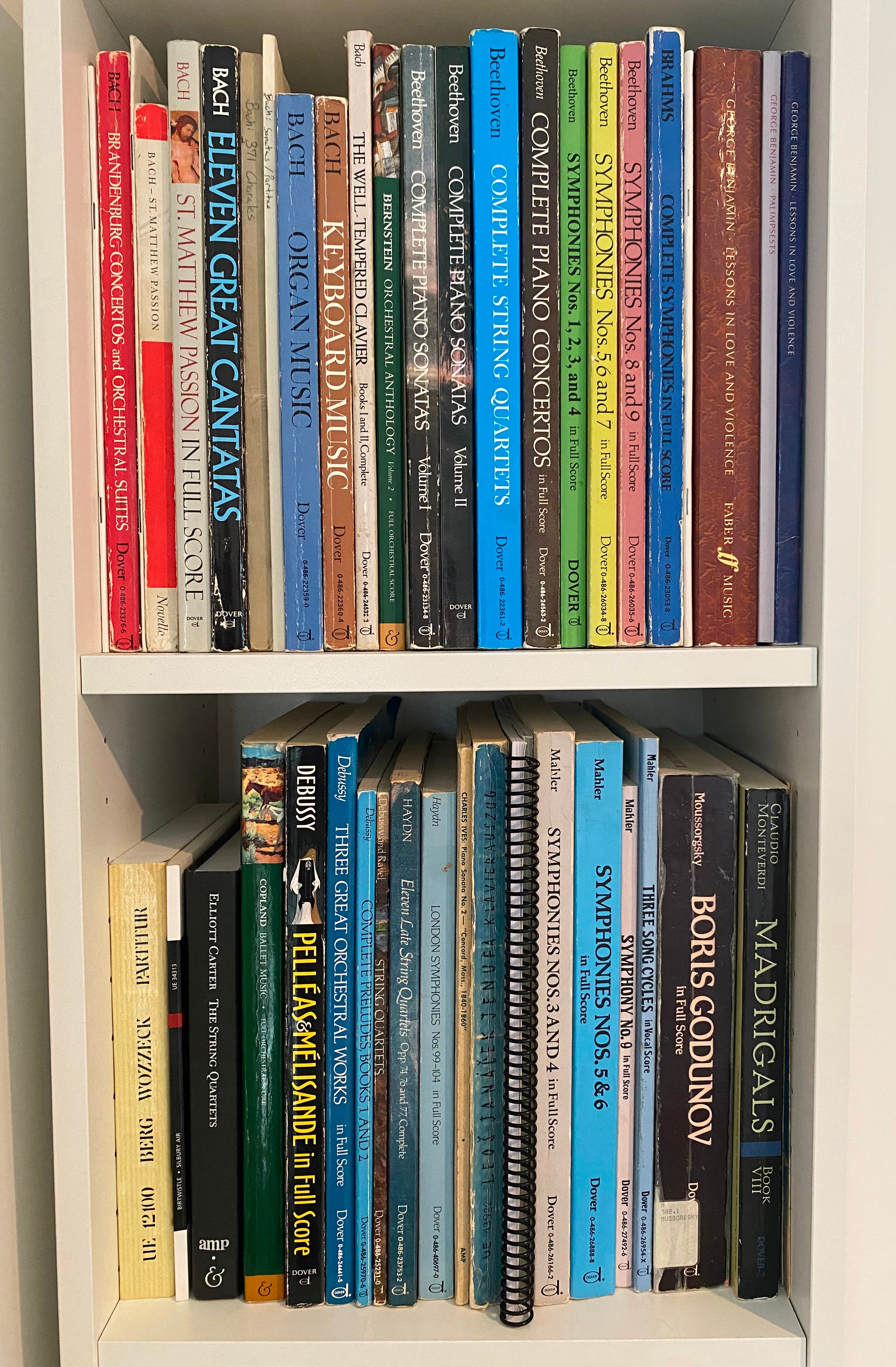
THE VAST MAJORITY OF MY EARLY EDUCATION in writing music was through studying scores. I didn’t formally begin studying composition (i.e. regular lessons and meetings with a teacher) until I was working towards my masters degree in composition at Indiana University. During my high school and undergrad years, I did attend a few summer music festivals where I would work with some composition teachers for a few weeks, but for the most part I mostly taught myself how to compose. And at the risk of putting myself out of a job, there are parts of me that believe that teaching oneself might be the best way, initially, towards writing music. You gravitate towards your own interests and let those interests guide your education.
When I was in high school, about once a month, I would trek down to the nearest university with a good music library—for me this was the University of North Carolina at Chapel Hill—and check out three or four scores. What “studying” those scores looked like back in high school was essentially listening to the piece while following along in the score. Not exactly studying, per se, but in those early stages of learning how to write music everything on the page and everything you hear is a discovery! You learn a hundred things from just a few minutes of music. Just seeing how an orchestra works together—who plays the melody, who doubles certain lines, how percussion fits into it all—is a kind of exponential learning process. Now eventually, once you start digging deeper into the score, there are things that you don’t know you don’t know—things to investigate you didn’t think were able to be examined—and then some outside guidance is helpful, putting me and my colleagues back into employment.
All this score studying that I did in high school and later in undergrad did come with some negative repercussions, as all methodologies do. When looking at a score too closely while listening to music, one has to ask themselves if they are truly hearing the thing itself, or being influenced by what they are seeing on the page. Can I actually hear that oboe line over that blaring brass chorale, or are my eyes confirming the presence of an oboe and, ta-da, I can hear it? When looking at a score while listening, it can also prove difficult to get a sense of how the music evolves and develops. You can see it happen, literally, in the gradual changes of black on the page, but you are not experiencing it. You are seeing all the road signs along the way, so any surprise destination is expected prior to arrival.
But in the way that aspiring novelists should probably spend some time reading and marking up some novels, and poets should scribble in the margins of some verse, composers should not just listen widely to music but get their fingers dirty with the material. I have found over the years that when I ask my undergraduate, and even graduate, students to study a score, they are often at a loss for what it means to study a score from the perspective of a composer. The score study practices of a conductor, largely, have a practical outcome: one should be able to know how the piece works so that a rehearsal can be successful. The score study practices of a theory student is also often clear cut: analyze this chord progression etc. etc.. But what is a composer supposed to take away from studying other people’s music? The word that comes up when I mention score study to my college composition students is “overwhelming.” Are they supposed to learn how the entirety of the piece works?! In that case, yes, it does sound overwhelming!
These are some ideas, tips, pointers from my own practice and what I tell my students about how to go about studying scores as a composer:
1. Two Methods: Mission Driven vs. Why This Now?
Generally—a broad generality—but generally I tell my students that there are two ways to score study. The first is a kind of mission driven approach. In this method, you are going into a piece with a specific musical element or aspect in mind. You are not trying to experience the piece as a whole, but to put it under the microscope and learn from one or two elements. For instance, if you are a string player and you have no idea what the woodwinds do in an orchestra, you might pick up Ravel’s Daphnis et Chloé and look at it solely from the perspective of how the woodwinds work together as a unit—a specific, yet mammoth, yet richly rewarding and important task! How does Sibelius blur big sections of music together? How does Stravinsky use percussion? How does Mahler morph one motive into the next in his Ninth Symphony? Just because you are not analyzing the whole of Mahler Nine does not make this method any less important. Studying just one composite part of the whole rarely just stays as one composite part; they eventually begin to speak to each other.
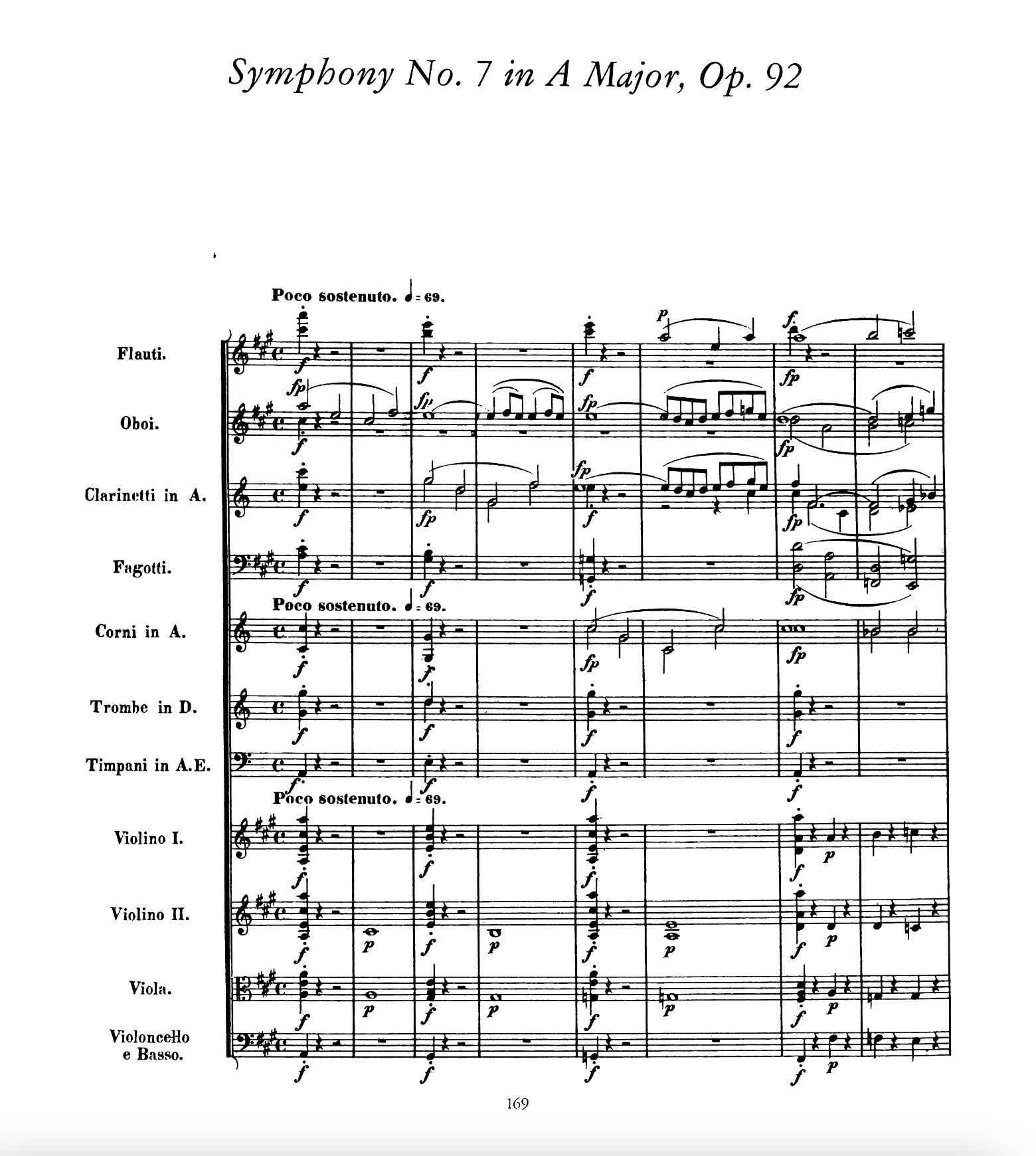
The second method—did I mention these are broad generalities?—is going into score studying largely blind and asking yourself this simple yet unbelievably difficult question: Why this now? If I look at the first page of Beethoven’s Seventh Symphony, I can ask myself this question dozens of times about seemingly anything on that page. Why does it start with a single bang in the orchestra? Why does it give way to a solo instrument? Why does an oboe, rather than another instrument, play that solo immediately after? Why does a clarinet take it over? Why only two dynamics? How does that initial solo get passed around, and how does it grow?
This is not an exercise in finding an actual answer. It is a tool that reminds you that none of this, nothing on that page, had to be the way it is! These were all choices. Are they the correct choices? Sometimes. Are they always deliberate? Sometimes. But this is for you to argue over while you study the music. The third word in this method, now, is vital. Why are these choices being made at this moment in the piece? This method can be a kind of daily practice. Spending ten minutes with a score, asking yourself why any of this is happening and making educated connections, will always yield a better understand of not just the piece in question, but music making more broadly.
2. Score Studying Is Not Harmonic Analysis
I wish I had known back in my undergraduate years that the way we analyzed scores in music theory class was not the same method to study scores as a composer. Now that I teach music theory to undergraduates, I try to stress this point to my composer-ly inclined students. By and large, the music theory classroom is rooted in the study of pitches and their combinations. A vitally important, richly nuanced, and unbelievably complex area of study! But, nonetheless, the music theory classroom would have you believe that analyzing harmonies is the sole purpose and method in which to study a score. By looking at harmonies on their own, you are missing how orchestration fits in, how rhythm plays a role, how form influences it, what the timbre of that chord is, how it functions with melodic ideas, etc. etc. One can get a richly rewarding experience from studying a score and never even addressing the harmony! (I wouldn’t advise it, but nonetheless you can).
I look back at some of my undergraduate scores and see page after page of Roman numeral harmonic analysis when, in actuality, it would have been far more helpful to study another aspect of the piece. For instance, studying a Mozart aria solely for the harmony can yield some interesting insights, but the harmonic vocabulary for the most part is easily understood and fairly predictable. Instead, look at how harmonies are approached by voice-leading, or how the singer works with or against the harmony, or how does the harmonic rhythm mirror the drama of the action on stage.
3. Create Your Own Terminology
Similar to the last point, don’t rest solely on terminology you learned in theory class. Form, for example, is not always best studied using terms like exposition, development, recapitulation, etc. I often mark-up or refer to formal sections in music with verbs, like the form is a living, breathing thing. I had this fantastic theater teacher in high school (shout-out to Gina Winter from Apex High) who had us study a list of “actions” and apply them to each line of dialogue in our script. It was insanely tedious, and like all good lessons that have lasting power I hated it when I was doing it. But, it made me realize that every line in a good play has an intention, an actionable intention, behind it. The same is true when looking at form: the new musical material cascades over the previous; it interrupts the old music; the instruments provoke each other; the meter erupts into timelessness! Good music, like good theater, has intention behind each action.
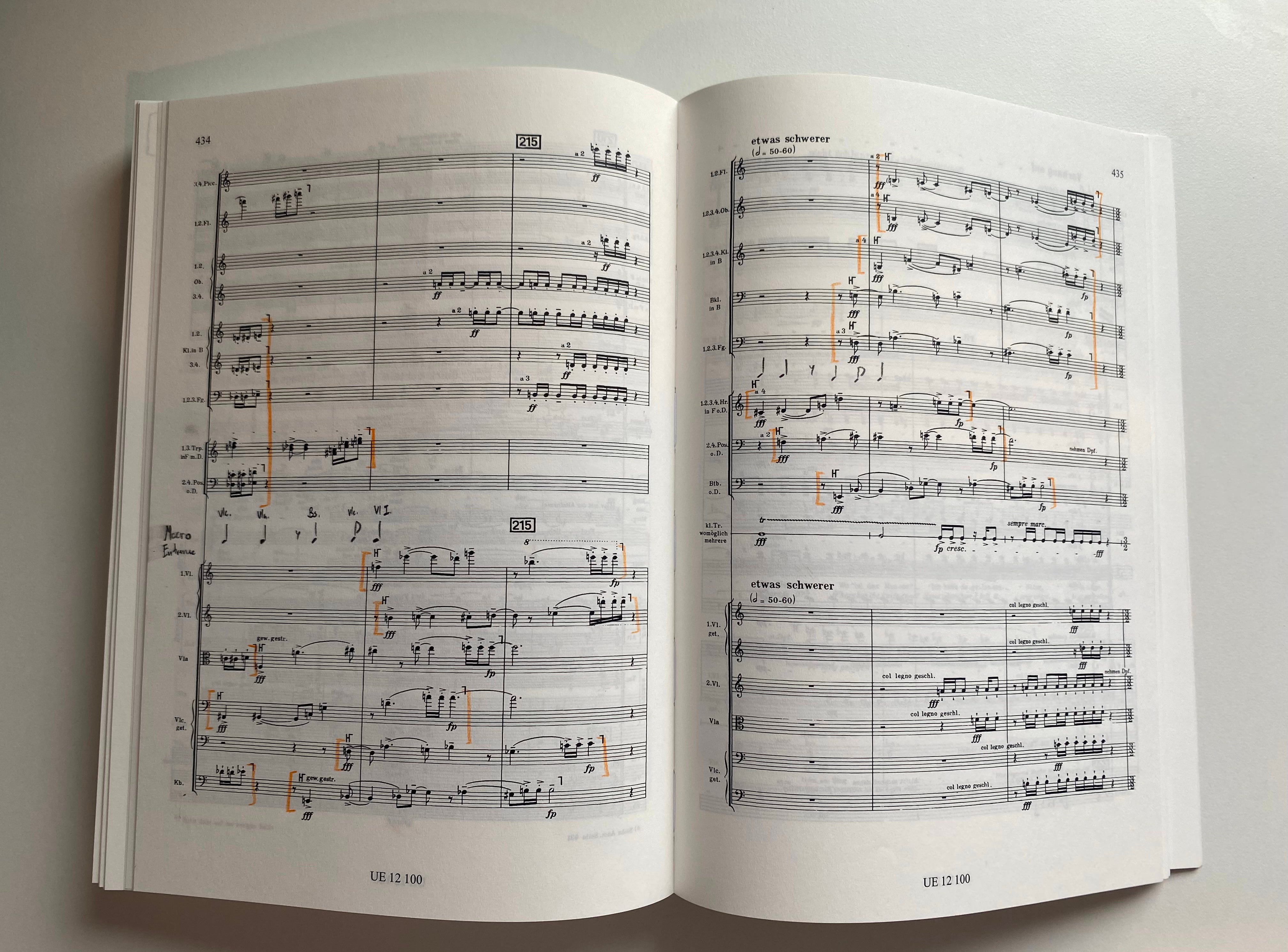
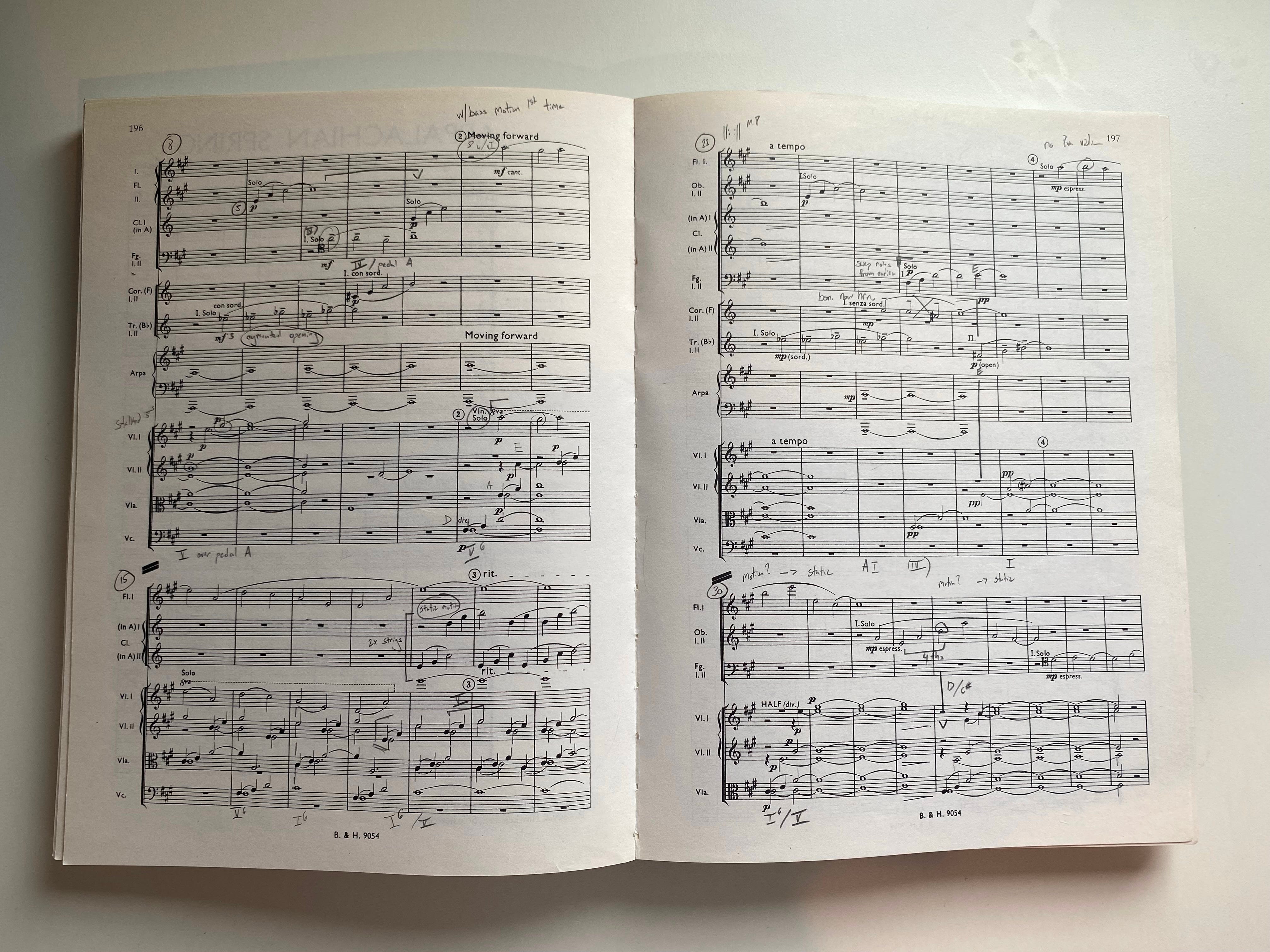
I will also come up with abbreviations and symbols that mean something to me, but would be complete wingdings to someone else. For instance, it takes a lot to convince me that a “new motive” in a piece is truly new and not just a transformation of a previous motive. Because of that, I don’t usually label motives as “A” or “B” but rather with some combination of Roman numerals and decimals: “I.1, I.2, I.3, II.1.” Other times I will use colored pencils when the music has several motive streams operating at once or when rhytmic units repeat and transform over time. I’ll often put “$$$” next to especially good timbres or “???” next to passages that seem—and sound after investigating multiple recordings—poorly written for the instrument.
4. It Is Important To Listen Without A Score
As I wrote earlier, as important as it is to “look under the hood” (i.e. look at the score), it is vital to experience whatever piece you are looking at as a listener. Beyond the conductor (if there is one) and the composer, hardly anyone ever looks at the score. But everyone listening does hear the piece as a purely sonic phenomena. You will inevitably pick up on aspects of the piece that are possibly loss when looking at a score. For example, those verbs that describe the form are usually best experienced away from the score. I tend to tell students to listen once without a score and a second time with a score in hand.
(A side note of score studying I haven’t mentioned so far: As convenient as YouTube score follower videos are, try to either find a physical copy or a PDF copy of the score online. It is difficult to study a piece frame by frame, and it will become increasingly easy to just follow the video than pause and actually study what is going on. Beyond IMSLP.org which houses nearly everything in the public domain, at this point a fair number of publishers let you peruse scores digitally for free, such as Boosey and Hawkes, Faber Music, and G. Schirmer. It is difficult to study a piece frame by frame.)
5. Take Notes (Yes, Words!)
I find it helpful, especially when picking up a score that I haven’t looked at for a while, to see little notes I wrote to myself in the margins. Obviously if this is a library score, do not mark it at all…just get yourself a notebook. I will often jot down questions I have, problems with certain aspects of the piece at that moment (“you cannot hear the clarinets at all in this texture”), aesthetic observations (“calm after the storm”), references to another work (I recently was looking at Christopher Rouse’s Rapture, and the opening rocking between I and ii reminded me of the opening of Sibelius’s Fifth Symphony).
The old cliche of music beginning where words end is (my apologies) complete garbage as far as I’m concerned. There are some pretty damn good words out there and some pretty bad music—I don’t think words begin where the worst music ends. Words—little memos, brief musings—can help you understand music. Where musical questions arise, words can, for some, begin.
6. Learn How Other Artists Study
During the pandemic year, I was in the second year of my doctorate with two orchestral premieres cancelled and absolutely no inspiration to write feedback canons for orchestra over Zoom calls. I was entirely unproductive that year. I was working that year with the great composer and all around mensch Eugene O’Brien who, beyond having an encyclopedic knowledge of music, was passionate about poetry, visual art, theatre, literature, etc. From what I recall from that, our lessons became conversations about art, broadly, and how one art form speaks to another one. I began reading the wonderful Paris Review interviews with authors and poets, that unlike other interviews out there, are almost entirely focused on the creative process and craft. I have learned so much about how to study music from learning how novelists study novels, poets study poems, architects study architecture. One methodology of study in one art form can morph into a methodology in music.
7. Ask Yourself Questions (and Be Okay With Unanswered Questions)
Perhaps the most important thing to remember is that you will never understand how a great piece of music works. No matter how much you study it, and understand how nearly every component is put together, there will still remain unanswered questions. The poet Elizabeth Bishop said that the three qualities she admired most in art were accuracy, spontaneity, and mystery. We can observe through studying scores the accuracy, maybe even some of the spontaneity (Harrison Birtwistle would often use random number games to generate his rhythms), but there will always be, thank God, mystery. If you are left with no questions after spending a good amount of time with a piece, you either didn’t look hard enough or it is a bad piece. Thinking about those lasting questions will beget some great art!
§
What all this studying will tangibly do to one’s writing is in some sense as complex and mysterious as writing music itself. What it will do is unlock possibilities, it will demonstrate how simple ideas and gestures can have a profound impact on a given musical moment. It will also equip you with a tool kit for expressive problem solving; you will begin to see how expressive and emotional states are translated into music by means of harmony, timbre, rhythm, structure, counterpoint, pitch, tessitura, orchestration, ornamentation, invention.
It is also just fun to learn! Yes, do it because it might gain some practical outcomes, but also do it because spending your time and attention on great art is always rewarding.
As always, the way you write is interesting to the musician, the composer and the average Joe who doesn’t know Beethoven from Sousa. Keep on educating the masses! You do it well.