

NO ONE EVER SUPPORTED ICE

IN APRIL OF 1945, THE AMERICAN WAR CORRESPONDENT MARTHA Gellhorn surveyed the post-war terrain from a series of small German villages along the Rhine. The rural Germans who lived in those towns had been the ideological backbone to Adolf Hitler’s rise in politics. Their simple aspiration was that the Nazi party would, in some semblance, bring the German nation back to its pre-World War One status as a mighty, prosperous nation. However, when Gellhorn interviewed those same people after the end of the war in Europe—after the concentration camps had been liberated, after Berlin fell to the Allied forces, after the dear leader had killed himself—she did not encounter the die-in-the-wool support she had expected. She wrote in Collier’s with more than a bit of suspicion:
“No one is a Nazi. No one ever was. There may have been some Nazis in the next village, and, as a matter of fact, in that town about twenty kilometers away it was veritable hotbed of Nazidom. To tell you the truth confidentially, there were a lot of Communists here. Oh, the Jews? Well, there weren’t really many Jews in this neighborhood. I hid a Jew for six weeks. I hid a Jew for eight weeks.
We have been waiting for the Americans. You came to befriend us. No, I have no relatives in the army. I worked on the land. I worked in a factory. Ach! How we have suffered! The bombs. We lived in the cellars for weeks. We have done nothing wrong. We were never Nazis!
It would sound better if it were set to music. They all talk like this. One asks oneself how the Nazi government to which no one paid allegiance managed to carry on this war for five and a half years. Obviously no man, woman, or child in Germany ever approved of the war.
Three decades later, when the French filmmaker Claude Lanzmann interviewed the same rural Germans and Poles who lived in the villages just outside the death camps for his masterful and sprawling documentary Shoah, he encountered a similar refrain. We tried to warn the people on the train! We all thought it was terrible! But when those who were on the trains were interviewed, they told stories of towns people who spit on them, mocked them, and made grave gestures of throats being cut. Those villagers, it seemed, were not Nazis either.
One hears a familiar strain, faintly, now drifting through American public life. In the aftermath of Alex Pretti’s murder this past weekend, those who once dismissed the killing of another Minnesotan, Renee Good, have begun insisting that they were never really all the supportive of ICE to begin with.
Laura Ingraham, the FOX News host who only days ago was broadcasting from Minneapolis, announced on Monday night that she had, upon reflection, never been fond of the Department of Homeland Security. “I have never been a big fan of DHS,” she said, reaching back to the ruins of 9/11 to explain that the whole project had always seemed like a needless uptick in bureaucracy.
Chris Madel, the Republican primary candidate for what will soon be Tim Walz’s vacant governorship, performed a similar maneuver. Only a week earlier, he had assisted ICE officer Jonathan Ross—the man at the center of Renee Good’s killing—in securing Justice Department legal representation should charges ever materialize. Now, with public approval tilting in the other direction, Madel discovered an unexpected reserve of principle. "I cannot support the national Republicans' stated retribution on the citizens of our state, nor can I count myself a member of a party that would do so," he said before announcing that he was dropping out of the race.
At the White House, the revisions were more carefully phrased. Press Secretary Karoline Leavitt insisted that no one in the White House had ever called Alex Pretti a domestic terrorist! This was, in the narrowest sense, true. Stephen Miller had called him an assassin.
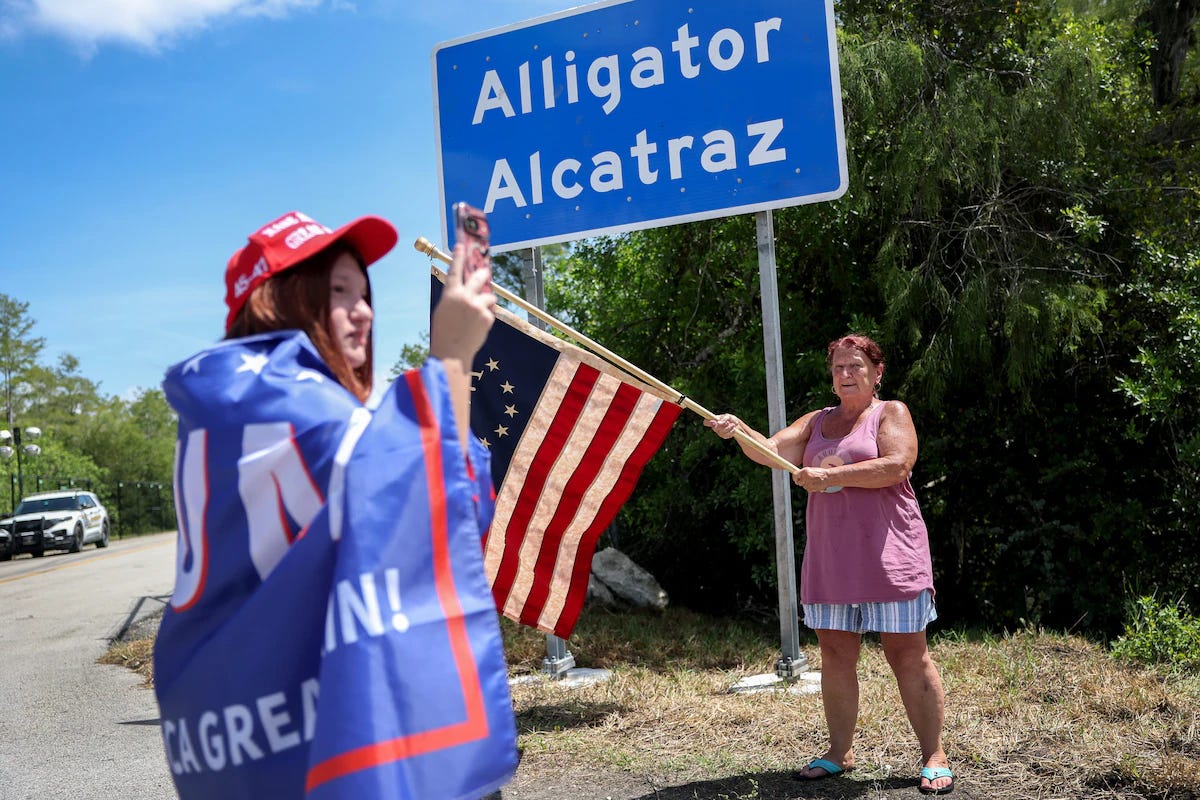
Some Republican voters are shocked, aghast, stunned, astounded that such things like the ICE takeover of Minnesota and the murder of Alex Pretti can happen. They “did not vote for this,” the tune goes. It does not seem to have occurred to them, while standing at a rally clutching a sign that called for “Mass Deportations Now,” that slogans are rarely content to remain on cardboard signs. Nor did it appear to register that waving American flags outside a deportation camp named “Alligator Alcatraz”—sounding more like a novelty attraction than a place of imprisonment—would add a touch of sadism to the ongoing purge against migrants. They enlisted in a campaign whose message, from the beginning, was astonishingly uncomplicated: that this country must be returned to an imagined past, and that the only thing standing in our way is a group of undesirables.
What did come as a surprise, apparently, was that such thinking, that such rhetoric, once aired often enough tends to acquire boots, uniforms, and a fondness for public violence.
Naturally, people change, and with them the angle from which they view the world. But these remarks from members of Trump’s cabinet or from right-wing media figures are not pivots. They are statements, delivered after the fact, that the speaker has all along been very cautious, all along been very doubtful and skeptical, all along stood on the correct side of the historical moment. With these statements, they wash their wrong doings away and emerge with clean hands. No one, it turns out, ever supported any of this!
“We are not having any of this story,” Gellhorn concluded in 1945, “and we stand around looking blank and contemptuous, and we listen without friendliness and certainly without respect. To see a whole nation passing the buck is not an enlightening spectacle.”
Well said!